
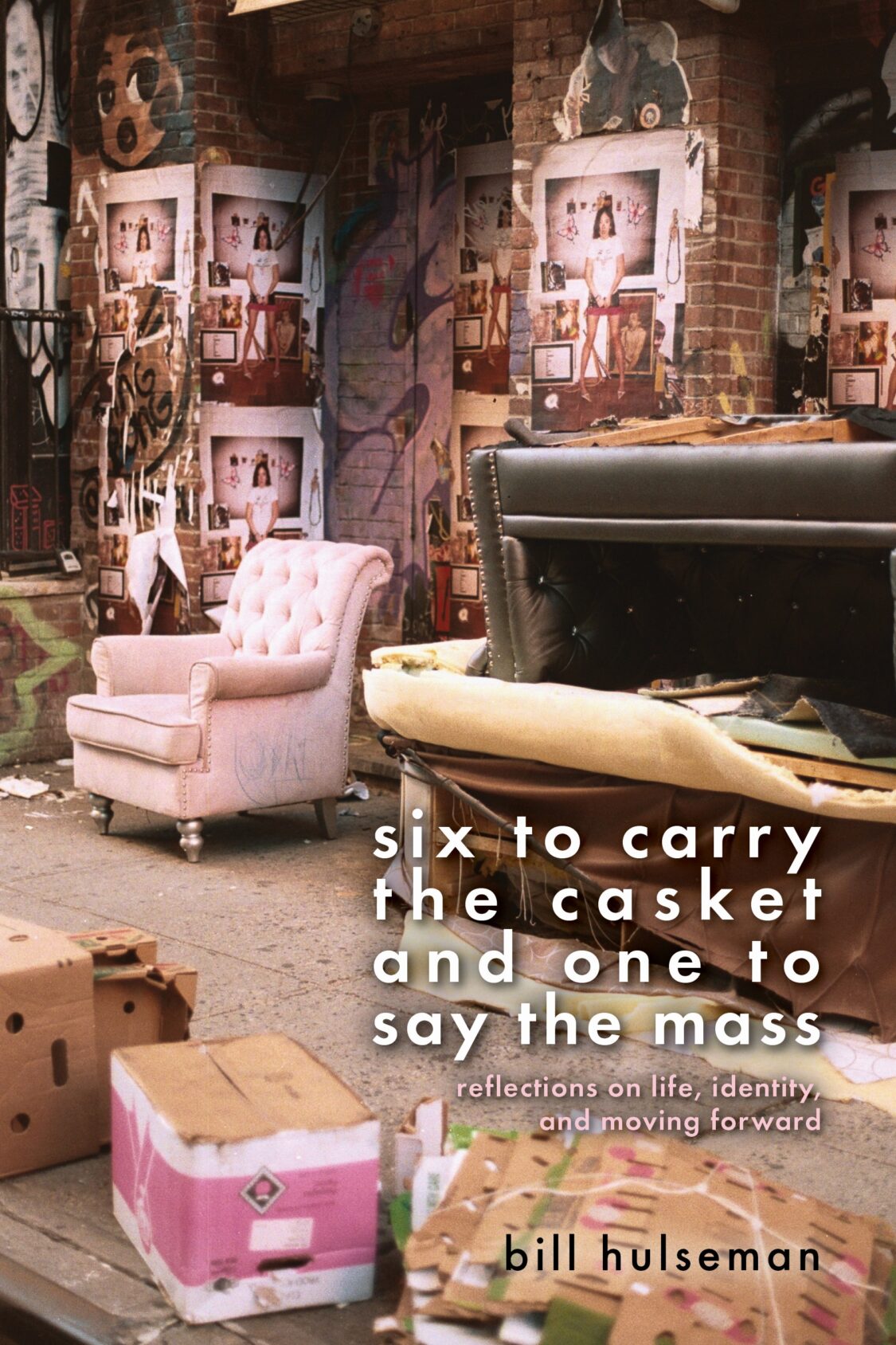
Step into an inspiring conversation with Bill Hulseman, author of six to carry the casket and one to say the mass. In this candid Q&A, Hulseman reflects on faith, identity, queer spaces, and the role of meditation in healing, while also sharing the personal stories and insights that shaped his journey.
Q. What are your thoughts on the new Pope? Do you think he’s “woke”?
Oh, you asked a theological question, so strap in. This theology nerd loves thinking about this. I never thought I’d see an American pope in my lifetime, but I’m thrilled to see a Chicagoan, and particularly this Chicagoan–an American-born Augustinian who has lived in Peru for the majority of his ministry. His election really reflects a shift in the College of Cardinals that nobody seemed to see coming, and to me the election of Cardinal Prevost suggests that the College sees the future of the Church far beyond the loggias and secrecy of the Vatican. That’s a very much needed glimmer of hope for me. From the moment he was elected, Prevost’s activity on social media bolstered his cred as a woke pope, and groups who have experienced marginalization in the Church have been watching his language and actions very closely.
So far, he’s committed to staying Francis’ course, emphasizing compassion over compliance and pastoral tone over theological doctrine…but not making doctrinal changes. In early September, James Martin, SJ, whose work focuses on outreach from the Church to LGBTQ Catholics, gave an optimistic report from his private audience with Leo about Leo’s support of this ministry, and soon after Leo made an observation about change that really resonated with me. Doctrinal change isn’t a matter of setting policy or of the goals of the people in power–it reflects a shift in belief from the ground up. That’s true for any kind of change, isn’t it? When the people in power treat laws and norms as their purview, that’s an imposition on society, not a reflection of a shift in society. Doesn’t that always lead to some kind of backlash? Leo suggested that using papal authority to make a change would be disingenuous, because the wider Church hadn’t come to that insight yet. Some folx snarled at that, like he was avoiding responsibility, but he didn’t shut the door on the question. I inferred the possibility that there was a tipping point, as there has been in any major change in the Church. Like any effective and sustainable change, the work, he confirmed, has to be done from the ground up.
“Woke.” Not gonna lie–it cracks me up that this word has become such a lightning rod. If someone called me “woke,” I’d wear it as a badge of honor because, to me, “woke” is just a contemporary way of saying “committed to social justice.” Since social justice is fundamental to Catholic theology and ethics, I’d be worried if the pope denied being woke, but I think Cardinal Prevost signalled that this would frame his mission as a Bishop of Rome when he chose the name “Leo.” Ok, here comes the theology nerd…
Adopting a name is a powerful symbolic choice that is part of many Catholic experiences–names chosen for a child’s baptism, for the sacrament of Confirmation, for members of religious orders, and, of course, for popes all tell stories about what or who is important to the adoptee. The names that popes choose are the first hint at their priorities and help Vatican-watchers anticipate what is to come. Wojtyla took the name John Paul II to honor his predecessor, John Paul I (who died, rather abruptly, a month after the conclave that elected him) and to signal continuity and stability. Ratzinger chose Benedict XVI to honor XV’s role as a peacemaker during World War I (something he aspired to, even if peacemaking isn’t prominent in his legacy), and Bergoglio’s choice of Francis indicated a radical reorientation of the Church’s focus–he was he the first to take the name of the saint from Assisi who devoted his life to the poor.
And now there’s Leo. The most recent Leo, number XIII, shifted the Church’s focus away from the internal obsessions of Vatican I reforms (or regressions, depending on your POV) toward addressing the problems of the modern world, including rapid industrialization, unchecked capitalism, an increasingly wide chasm between the rich and the poor, degradations of human dignity, and destruction of the natural environment. His 1891 encyclical Rerum novarum provided the foundation for “Catholic Social Teaching, ” for which theologians have identified seven principles or areas of concern for Catholic Social Teaching–the life and dignity of the human person; call to family, community, and participation; rights and responsibilities; preferential option for the poor and vulnerable; dignity of work and workers’ rights; solidarity; and care for God’s creation–concerns that also happen to motivate various civil rights and post-colonial movements. You know, those movements whose tenor and impact are described as “woke.” By choosing “Leo,” XIV told the world that social justice–specifically, the vision of social justice reflected in Catholic Social Teaching–would be his priority. Sounds pretty Catholic to me, but if you call it “woke,” I don’t mind.
Q. What would a truly inclusive Church look like?
Well, we don’t have time for a full semester on ecclesiology, so let me just offer three suggestions.
First, a stronger intellectual foundation for Catholics: Catholics should be better educated about the theology and philosophy underlying Catholic practice and faith. In Catholic schools and parish education programs, the focus is imbalanced–too much emphasis on liturgical choreography that perpetuates heavily gendered, classed, and culturally biased practices and beliefs; too much reliance on past definitions of “good” and not enough unpacking of cultural assumptions and prejudices that manipulate theological insights; not enough emphasis on making space for wonder and awe; and not enough cultivation of conscience and personal agency. This responsibility rests on the shoulders of every-day Catholics, too, not just institutional practices. I was lucky to grow up in a house hearing my parents talk about the Church, about faith, about how their experiences challenged or were guided by their faith or Church teaching. And they openly disagreed with the pope, with Catholic officials, and with Church teaching on a variety of topics. Observing my parents and engaging with them gave me room to play with ideas, to expand or deepen my understanding of something, and to identify how my life and religion were or weren’t integrated. With a stronger intellectual foundation, it would be easier for us to see and address injustices, prejudices, and other degradations of human dignity and God’s creation. It would be easier to see that difference in terms of gender and sexual identities is not an aberration but a revelation. Instead of condemning differences, we could be asking what they reveal about God.
Second, dismantle the Eurocentrism of the Church. This is something I gleaned from Shusaku Endo’s Deep River many years ago and helps me see the Church’s complicity in European colonization around the globe–the global, post-colonial Church, aka Catholics around the world, should be more interested in understanding how our different geographic and cultural experiences impact us differently and provide valuable and distinct lenses for hearing and interpreting the Gospel. If the Gospel embodies truth and is universally relevant as Christians believe, then we should actively invite new insights from various cultural perspectives, not gate-keep and prop up the Eurocentrism that still dominates Catholic thinking. Our faith and practice would be bolstered and more beautiful with practices and reflection that resonate with local vernacular instead of imposing European ideas and assumptions.
Third, spark our individual and collective imaginations. John XXIII encouraged Catholics to continually open the windows and air out the Church, to pay attention to the “signs of the times.” To grow in inclusion, especially when it comes to inclusion of LGBTQ people, we need to hypercharge our imaginations to reach beyond our ancestors’ limited worldviews and rethink core ideas like “generative” and “procreation.” See, Catholic sexual ethics are rooted in a particular understanding, that actions that produce life–that are “generative” and “procreative”–are good, and actions that don’t are not good, or “evil.” (Now, before you attack the good/evil binary–that doesn’t really exist. In a theological sense, which doesn’t translate easily to our vernacular, “evil” just means “the absence of good.” The association of “evil” with sinister and demonic forces is a cultural conflation that is wielded as a weapon for exclusion.) In this case, uninhibited heterosexual sex is the most direct path to producing life, so that’s “good.” But because we cling to a very literal understanding of God’s first commandment to humans (“Be fruitful and multiply!” as Genesis tells us), any sexual acts that don’t potentially introduce a sperm and an egg–solosexual sex, homosexual sex, various sexual positions–are “evil,” and because of the conflation of “evil” with the Devil, anyone who engages in those acts get Scarlet Letter-ed and classified as sinister forces.
But not all non-generative sex is restricted–there’s a loophole, and this should raise the alarm bells for anyone looking for logic. Heterosexual sex between people who can’t produce a child (because of infertility, post-menopausal status, or other medical conditions) is condoned because, well, there’s a chance that a miracle might happen, just like the aged Elizabeth and her virginal cousin Mary in the Bible. Yeah, the miracle loophole (which applies only to cisgender heterosexuals). If we can look past our biological capabilities with wonder and curiosity, I think we would come to a broader and more inclusive understanding of what creating and sustaining life means. Doesn’t it also mean cultivating good and just relationships? serving others, aiding people in need and protecting people in danger? creating art and developing the intellect and other capacities and media to know and praise God’s presence?
Thank you for coming to my TED Talk.
Q. What are your weekly meditations about, and how do they connect to your book?
During 2020 and the height of quarantine, I started offering meditations via Zoom. I think we all wanted to do something, right? Over time, I’d developed my own meditation style, both for myself and for students in my courses and on retreats. My style taps into various methods that I’ve learned in different places and times–a little centering prayer, a little vipassana, a little Examen, a little gratitude, a little contemplation. The goal of the meditation isn’t rooted in any particular religious or philosophical idea–my goal is to practice being present. And in 2020, we all needed more practice with that. I thought a bit about how to adapt my meditation practice for the Zoom world, and then I started spreading the word on the socials. On top of making space for some peace and quiet, it gave me a chance to reconnect with friends and colleagues in different places and from different times in my life. Even as the pandemic faded and something-like-normal life resumed, people kept coming. Sometimes it’s two of us, sometimes it’s a dozen. I don’t expect anyone to register or return–I just try to keep the door open to anyone who is looking for some peace and quiet.
I begin by offering guidance on settling in, both physically and mentally, with mindful breathing. We have a moment of quiet. I read a text–usually a poem or an excerpt from an essay or book–and folx can reflect on the words or ignore them and stay focused on their breath. After another moment of quiet, I invite everyone to consider what they’re feeling particularly grateful for in that moment, and then we emerge. To wrap up, I invite everyone to name something they’re grateful for, something that came up for them, and then we sign off. I’ve welcomed folx from various religious (and non-religious) backgrounds with longstanding contemplative practices and people who are trying it for the first time.
I don’t talk about meditation in six to carry the casket, but both the book, these meditations, and my ritual design work all come from the same source–a deep desire to reflect and make meaning. For me, the best way to reflect is in dialogue with others–I really like to share experiences with people, to talk about what I’ve learned, and to hear what others are learning, too.
Q. Why did you write “six to carry the casket and one to say the mass” now?
The book emerged from a moment of profound transformation for me. After two decades in education, in the hardest job I’d ever done, and under the weight of grief from the loss of my parents and a sibling, I burned out. After taking some time to heal, I started writing as a way to process how I landed in that place, but just as I was starting to rebuild, 2020 happened. I kept writing to try to understand how we all landed in that place and what we needed to do to move forward. That writing eventually morphed into a book because I wanted to offer others the tools of reflection that have served me well, the methods and insights that helped me understand who I was, who I wanted to be, and the world I want to live in. I suspect that many folx face those questions but don’t know how to engage them, so I hope that six to carry the casket not just gives them an example but also shows that it’s worth the time and effort, it’s worth the journey into past dark and lovely experiences and revisiting all the memories and feelings that came with them.
Q. What do you hope readers take away?
It’s not about me. Well, ok, the book is literally all about me, but I’m not interesting enough to merit a memoir. Instead, I hope readers feel impelled to reflect on their own experiences and to identify the relationships and experiences that shaped them.
Q. What would you say to queer students you taught in the past?
Wanna get brunch?
And then, at brunch, I would say I’m sorry if I ever suggested in words or in examples that it was ok to leave part of yourself at the door.
Q. How important were Queer spaces to you while growing up? Talk about how they helped you see the outside world you felt trapped in.
I grew up with a great amount of safety and privilege in a lovely corner of the world, but one of the insights I gleaned from writing six to carry the casket is an awareness of how the world I grew up in was not built for me. I mean, if you look at me–I’m a White, cis, man who looks pretty comfortable in a suit–I look like I’d blend perfectly into suburban bliss, but in reality I spent a lot of time and energy as a kid trying to survive, to keep my head above water, and blaming myself for being insufficient, for never quite being enough, for never quite fitting in.
Many of the essays in six to carry the casket reflect on many of the people, places, and experiences that gave me language to understand myself and to navigate the world. For gay men, you might’ve heard that one of our most important relationships is with our divas. Even as a kid who was floating and isolated, I could hear my loneliness and longing in Ella Fitzgerald’s voice. I felt bold and fearless when I sang along with Ethel Merman. I found language and empowerment (and a whole lot of joy) with Madonna. I would never meet those people, but their art and their performances inspired hope in me and served as a beacon for me to follow.
Once I got to college and was open with my sexual identity, I actively sought out queer spaces and voices. During my Junior year, I took a course on gender and sexuality in film and literature and was introduced for the first time to stories that actually resonated with my experiences. I felt myself connected and drawn to spaces well beyond the boundaries of the suburbs. Edmund White invited me into the experience of the Stonewall riots. Paris Is Burning welcomed me into the Ballrooms and Legendary Houses of New York. The Front Runner showed me that my life wasn’t doomed to caricature or tragedy, that my desires were real and valid.
Once I got to college and grad school and could really explore queer spaces, I found places like Berlin (in Chicago) and ManRay (in Cambridge) that fostered a kind of communal connection I’d never experienced before–places built by and for queer folx that gave me everything the suburbs couldn’t. I had opportunities to identify and push my boundaries and to take ownership of my body. I got to know people as they wanted to be known and was able to blur the boundaries of race, class, and gender that were so firmly reinforced in suburban life. But, most importantly for me, when I stumbled into the monthly Madonnarama party at Berlin–I can only describe it as a sense of homecoming, of having found my tribe. And I’d acquired a new lens through which to see the world, one that brought into focus things I couldn’t (or maybe just chose not to) see–both the trappings and insularity of privilege and the gorgeous diversity of the people and the wider world.
Q. What do you wish older siblings understood about the impact they have?
As my aunt has always said, “It’s hard to be the youngest.” Sure, it looks like we’re spoiled and we are the favorites. And sure, that’s all true. But we also enter the world constantly 15 steps behind the older ones. They’ve already set the dynamics of family culture, making it that much harder to feel like we can contribute, and so many of us youngest know the experience of “Oh, you’re so and so’s little sibling,” and immediately inheriting whatever baggage the older ones have left behind. I’ll never understand why, because I’ve never had younger siblings, but unless they actively work to maintain a relationship and get to know us as adults–you know, as people– we’re perpetually 8 years old in their eyes.
But here’s the thing: we at the end of the line see and hear everything. We watched you grow up. We learned from your successes, and if it seems like our parents were more lenient with us, it’s only because we learned not to repeat your mistakes. When you leave the house, we’re stuck with whatever mess you left behind.
Q. How can people construct their identity without falling into arguments or defensiveness?
First, think of “identity” less as a label, a fixed name or box, and more as a window, as an insight into our experiences and values. And as with windows in a home, it’s a privilege and a sign of proximity to be able to peek into a neighbor’s window, to see into their home, but residents might also pull the curtains closed–if someone hasn’t opened a window for you to see into, keep walking.
Second, respect the identities people claim for themselves, and don’t impose your identity language on others. This is where we could invoke the “Golden Rule” more assertively–if you want me to see you for who you are, as you understand yourself, then I can expect you to see me for who I am, as I understand myself. To do this effectively, I think it helps to prioritize listening when meeting someone and to practice the art of restraint, to think twice (or thrice) before imposing an identifier on someone.
Finally, remember that, even and especially when we share an identity with someone, when we’ve shared part or much of a path with others, we travel with different questions and require different answers. We miss the opportunity to know and bring out the best from each other–and to be known and become our best selves–when we start with fixed assumptions, not earnest questions.
Q. How do we begin to question the identity we’re given at birth?
Well, first, let’s recognize who gives us that identity. My parents, my siblings, and the immediate world around us gave me my first identity. Some of the things that I inherited with that first identity continued to serve me, some didn’t. That forced a decision for me–do I hold on to it, or do I leave it behind? Some decisions were easy–I never want to live in the suburbs again, I embrace my identity as a gay man, and as a queer person and am acutely aware of heteronormativity and heterosexism in the identities given to me. Some decisions were tough–rejecting generations of family norms, I didn’t invite one of my siblings to my wedding.
As I grew, though, I stepped farther and farther outside that circle, I’ve had experiences that opened my eyes to new ways of understanding myself and my place in the world. Those experiences help me to continually shape my identity. I find great inspiration in the words of Christian Wiman. In My Bright Abyss, he wrote, “if you believe at fifty what you believed at fifteen, then you have not lived–or have denied the reality of your life.”
Rapid Fire
- Holding a Puppy or Holding a Baby? – Baby. Never wanted my own, but I love babies.
- Invisibility cloak or sparkling skin? – Invisibility cloak. “Sparkling skin” sounds like the result of a bad run in with a glitter-covered drag queen, and it is impossible to get rid of glitter.
- Coffee or tea? – Coffee. I respect tea, but coffee and me, we go way back.
- Dinosaurs or princesses? – Dinos.
- Laptop or phone? – Laptop. No, wait…phone. No, wait…laptop. No, wait…
- Mountain or Beach? – Is “City” not an option?
- Having a dog or having a cat? – Dog. For me and my allergies, cats=death.
- Fame or Fortune? – Fame. Mostly because the theme from the 80s show pops into my head as soon as I see the word…I’m gonna live forever, I’m gonna learn how to fly–high!
- Love or Money? – Define “love.”
- Scented Candles or Incense? – Incense.