
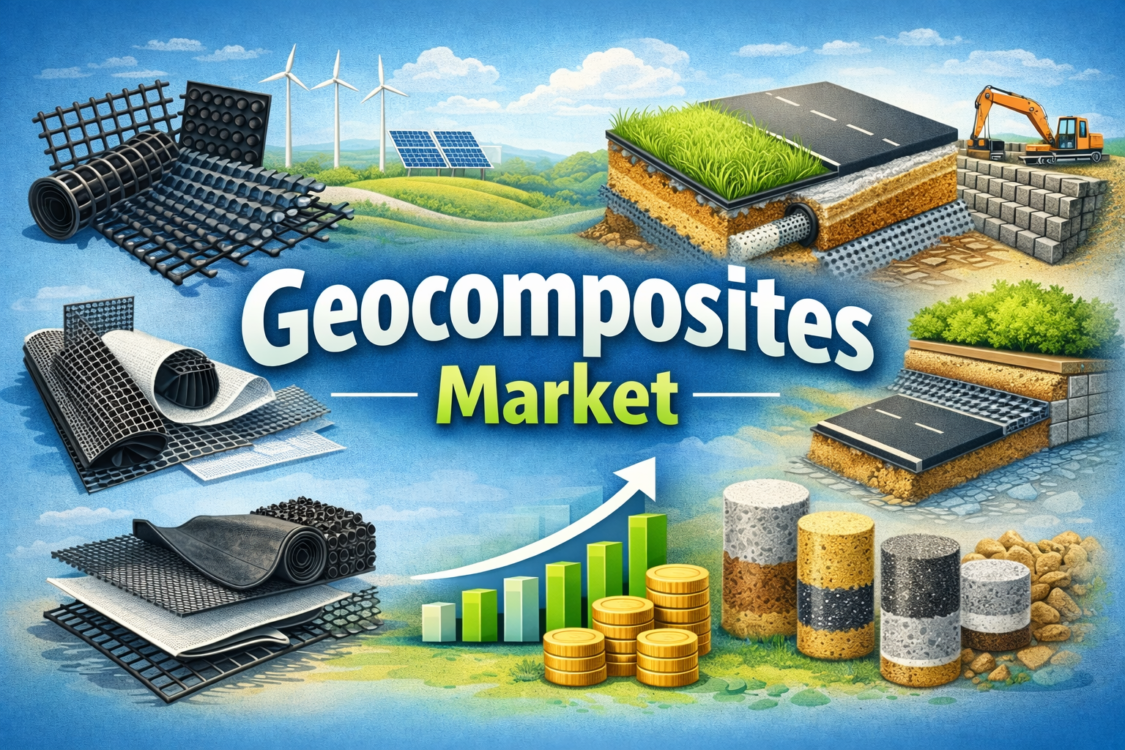
Rapid urbanization, expanding infrastructure projects, and the growing need for sustainable construction materials are driving the adoption of advanced geosynthetic solutions worldwide. Among these, geocomposites have emerged as a critical material in modern civil engineering due to their multifunctional properties and cost-effectiveness. The Geocomposites Market size was valued at USD 445.3 million in 2023 and is expected to reach USD 776.0 million by 2032, growing at a compound annual growth rate (CAGR) of 6.4% during the forecast period from 2024 to 2032. This steady growth highlights the increasing importance of geocomposites in infrastructure development and environmental protection projects.
Understanding Geocomposites and Their Role
The Geocomposites Market focuses on engineered materials formed by combining two or more geosynthetic components—such as geotextiles, geomembranes, geogrids, or geonets—into a single product. This multifunctional design allows geocomposites to perform several roles simultaneously, including drainage, filtration, separation, reinforcement, and protection. Their ability to deliver enhanced performance compared to single-component geosynthetics makes products in the Geocomposites Market highly suitable for complex and demanding construction environments.
These materials are widely used in roads, railways, landfills, retaining walls, embankments, tunnels, and hydraulic structures. By improving soil stability and controlling water movement, geocomposites help extend the lifespan of infrastructure while reducing maintenance costs.
Key Drivers Supporting Growth
One of the primary factors driving the growth of geocomposites is the surge in global infrastructure development. Governments across both developed and emerging economies are investing heavily in transportation networks, smart cities, and public utilities. Geocomposites offer a durable and efficient solution for managing soil and water challenges commonly encountered in large-scale construction projects.
Environmental regulations are also contributing to increased adoption. Strict guidelines related to soil erosion, waste containment, and water management have encouraged engineers and contractors to use materials that meet sustainability and performance standards. Geocomposites play a vital role in landfill liners, leachate collection systems, and erosion control measures, supporting compliance with environmental norms.
Applications Across Construction and Environmental Sectors
The transportation sector represents one of the largest application areas for geocomposites. In road and railway construction, they are used for drainage layers, subgrade reinforcement, and separation of soil layers. These functions help prevent water accumulation, reduce structural deformation, and improve load-bearing capacity.
In environmental engineering, geocomposites are extensively used in landfill construction and wastewater management systems. Their high permeability and filtration efficiency enable effective drainage while preventing soil contamination. Similarly, in hydraulic applications such as canals, dams, and reservoirs, geocomposites provide protection against erosion and seepage.
Slope stabilization and retaining wall construction further highlight the versatility of geocomposites. By reinforcing soil and enhancing drainage, they help mitigate landslide risks and maintain structural integrity in challenging terrains.
Regional Insights and Market Trends
North America and Europe currently hold significant shares of the geocomposites market due to well-established infrastructure, stringent environmental regulations, and widespread adoption of geosynthetic technologies. These regions benefit from advanced engineering practices and high awareness regarding the long-term cost savings offered by geocomposites.
The Asia-Pacific region is expected to witness the fastest growth over the forecast period. Rapid urban expansion, increasing population, and large-scale infrastructure initiatives in countries such as China, India, and Southeast Asian nations are driving demand. Additionally, rising investments in flood control, transportation corridors, and waste management projects are accelerating adoption.
Challenges and Technological Advancements
Despite strong growth prospects, the geocomposites industry faces challenges related to raw material price volatility and limited awareness in certain developing regions. In some markets, traditional construction materials are still preferred due to lower upfront costs, even though geocomposites offer superior long-term performance.
However, ongoing technological advancements are addressing these challenges. Manufacturers are focusing on product innovation to improve durability, strength, and ease of installation. The development of customized geocomposites tailored to specific project requirements is further enhancing their value proposition.
Future Outlook
Looking ahead, the geocomposites market is poised for sustained expansion through 2032. The increasing emphasis on resilient infrastructure, climate-adaptive construction practices, and sustainable development will continue to drive demand. As engineers and policymakers recognize the long-term benefits of geocomposites, their adoption is expected to move beyond large-scale projects into more routine construction applications.
With the market projected to grow from USD 445.3 million in 2023 to USD 776.0 million by 2032 at a CAGR of 6.4%, geocomposites are set to play a vital role in shaping the future of global infrastructure. Their ability to combine performance, durability, and environmental responsibility positions them as an indispensable material in modern civil and environmental engineering.