
|
What this covers
|
The word minimalist has been doing marketing work for so long that it has stopped describing anything. In desks it usually means thin legs, a pale top and a product photograph containing one laptop and a plant.
None of that is a property of the desk. A minimalist desk is defined by what it conceals rather than by its size. Judged that way the category sorts itself very differently, and several of the desks that photograph best come out badly.
Small and Minimal Are Different Claims
A narrow desk is a small desk. It occupies less room, holds less, and is still there at every hour of the day.
Minimalism is about visual and practical quiet: how little the object asserts itself, how little of it you have to look at, and how little maintenance the arrangement needs to stay that way. A large desk with nothing visible on it and no cables reads as more minimal than a small desk with a power brick hanging off the back, and the photographs bear that out immediately.
So the useful test is not how few inches a desk takes up. It is how much of it you notice.
The Four Things Actually Being Measured
Four criteria do almost all the work, and all four are checkable before purchase.
Surface-to-footprint ratio measures usable work surface against the floor area occupied. A desk with a wide top and a narrow base scores well. A desk with a heavy pedestal or a chunky cross-brace at floor level scores badly, because the floor space it consumes exceeds the surface it delivers.
Cable discipline. Whether power and routing live inside the frame or drape across the room.
Visible hardware. Brackets, crossbars at shin height, exposed bolt heads, levelers. Each is a small piece of visual noise and they accumulate.
The storage answer. Minimal desks rarely have drawers. That is acceptable only if there is a real answer to where things go, and the desk itself is part of that answer or it is not.
|
Desk type |
Surface to footprint |
Cable discipline |
Visible hardware |
Storage answer |
|
Trestle |
Poor, legs splay outward |
None built in |
High, exposed at the joint |
None |
|
Pedestal with drawers |
Poor, the base is solid |
Usually none |
Low |
Built in |
|
Wall mounted floating |
Excellent, no floor contact |
Good, hidden behind the wall |
Low |
None |
|
Thin-leg writing desk |
Good |
None |
Low |
None |
|
Folding and stowable |
Excellent when stored |
Varies, best when integrated |
Varies |
The desk itself leaves |
A trestle desk exposes its hardware at the joint. It is the shape most associated with minimalism and the one that scores worst on the criteria, which is a fair summary of how little the aesthetic and the property overlap.
Cables Are the Thing That Ruins It
Visible cables undo a minimal setup faster than visible objects. An object on a desk reads as intentional. A cable reads as a failure to finish.
There are five cables in a typical setup and each has a different solution:
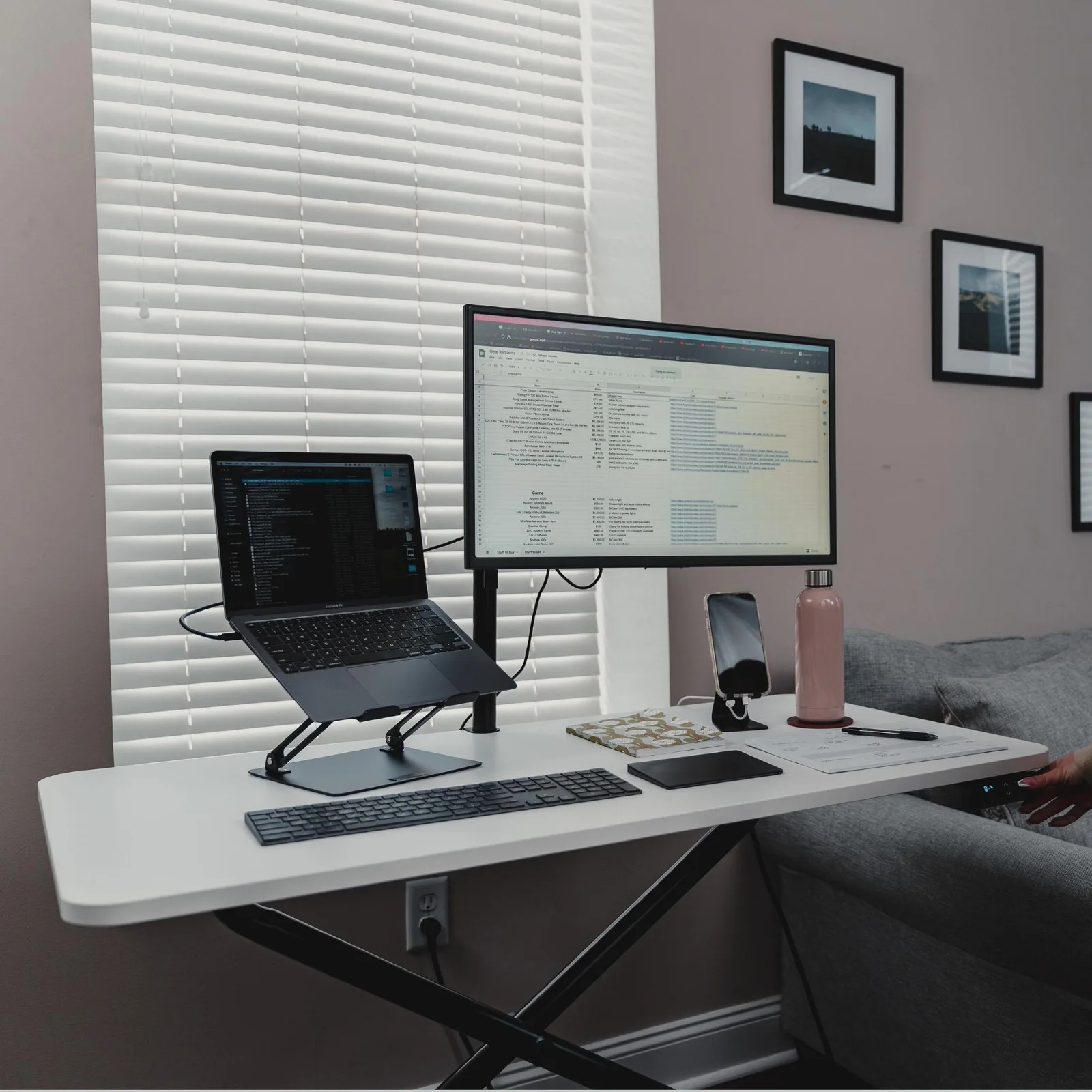
- Monitor power and signal. These follow the monitor, so the fix is to fix the monitor. A monitor arm removes the monitor base from the desk surface and gives the cables a spine to run along.
- Laptop charger. The brick is the ugly part, not the cable. It belongs off the surface and off the floor, clipped under the desk or on the frame.
- Peripherals. One hub on the desk, one cable to the laptop. Five cables become one.
- Desk power, on an adjustable desk. This one has to reach the wall permanently and it is the cable most often left crossing open floor.
- Everything else. Anything charged occasionally should be charged somewhere that is not the desk.
The principle behind all five is the same: make the desk the destination for cables rather than a place they pass through. A desk with a strip on the frame has one cable leaving it. A desk without has as many cables as it has devices.
The arithmetic is worth seeing laid out, because the reduction is larger than it sounds.
|
Setup |
Cables crossing the floor |
Cables visible on the desk |
|
Nothing managed |
4 to 6 |
4 to 6 |
|
Power strip on the floor |
1 |
4 to 6 |
|
Strip on the frame, no arm |
1 |
2 to 3 |
|
Strip on the frame, monitor on an arm |
1 |
0 |
|
All of the above, on a desk that stows |
1, removed nightly |
0 |
The jump that does the most visible work is the last two rows, and neither requires buying anything described as a cable management product. One is a mounting decision and the other is a frame feature. Most cable tidies sold for desks are solving the middle row, which is the row where the cables were already mostly hidden.
The Storage Answer Nobody Gives
Drawerless desks require storage to exist elsewhere in the room. This is the criterion that separates a considered minimal setup from a photographed one.
The photograph shows a clear desk. It does not show where the notebook, the charger, the headphones, the external drive and the pile of paper went. In a real room they went somewhere, and if that somewhere is a chair or the floor, the room is less minimal than it was before the desk arrived.
Three honest answers exist:
- The desk has drawers. Costs surface-to-footprint, gains a place to put things.
- Storage lives elsewhere. A shelf, a cabinet, a box. The desk is clear and something else is holding the objects.
- The desk goes away. A desk that stores away returns its entire footprint, and the things that were on it go into the same routine.
The third answer is the only one that resolves rather than relocates the problem, which is why collapsible designs keep appearing in genuinely minimal rooms rather than merely photogenic ones. A survey of minimalist desk setups built around that idea tends to look different from the usual gallery, because the desk is not the hero of the photograph at all.
Materials Behave Differently Than They Photograph
Three finishes dominate and each has a practical characteristic worth knowing before committing.
Wood and wood veneer hide small marks in the grain and develop wear that reads as age rather than damage. It is the most forgiving surface over years.
Powder-coated metal is durable and holds an edge cleanly. It shows dust more than wood and stays cold to the wrist in a cool room, which matters more than it sounds like it should over a long session.
Painted MDF gives the cleanest, most uniform surface and is the least forgiving of impact. Chips at the edges are permanent and visible.
Across all three, a matte finish shows fingerprints less than a gloss finish. Gloss white photographs beautifully and requires wiping constantly, which is the opposite of low maintenance.
Lighting Is the Part That Gets Skipped
Most minimal desk setups are lit entirely from above, because that is what the room came with.
Overhead lighting casts shadows from the front edge of a desk, and from your own hands and head onto the work surface. It also produces reflections on a screen from directly behind the viewer, which is the hardest angle to fix.
A minimal arrangement needs exactly two lights:
- One warm, low, at the side. A single lamp with a small footprint, positioned on the non-dominant-hand side so it does not shadow writing.
- One behind the monitor, facing the wall. Bias lighting reduces the brightness contrast between screen and wall and makes long sessions easier on the eyes.
Two fixtures, neither on the ceiling. That is usually the whole lighting design, and it does more for how a desk feels than any surface choice.
Height Cannot Be Styled Around
Desk height is set by human anatomy rather than by visual style. Forearms roughly parallel to the floor, shoulders down, screen top near eye level. Those requirements do not care what the desk looks like.
This is where a lot of minimal furniture quietly fails. A slim writing desk at a fixed height suits one body. Everyone else compensates with the chair, which moves the problem to the feet, or with a stack of books under the monitor, which is the least minimal object in the room.
An adjustable frame solves it structurally, and the visual cost is a column rather than a leg. That is a smaller compromise than it appears once the alternative is counted honestly, because the books, the riser and the footrest are all objects too.
Keeping It That Way
A minimal desk is not a purchase, it is a maintained state. Three habits hold it:
- Everything on the desk has a home that is not the desk
- Nothing is put down “for now”
- The surface is cleared at the end of the session, not at the end of the week
Those are the same three habits regardless of which desk is underneath them, which is worth saying plainly. The desk makes the state easier or harder to hold. It does not hold it for you.