
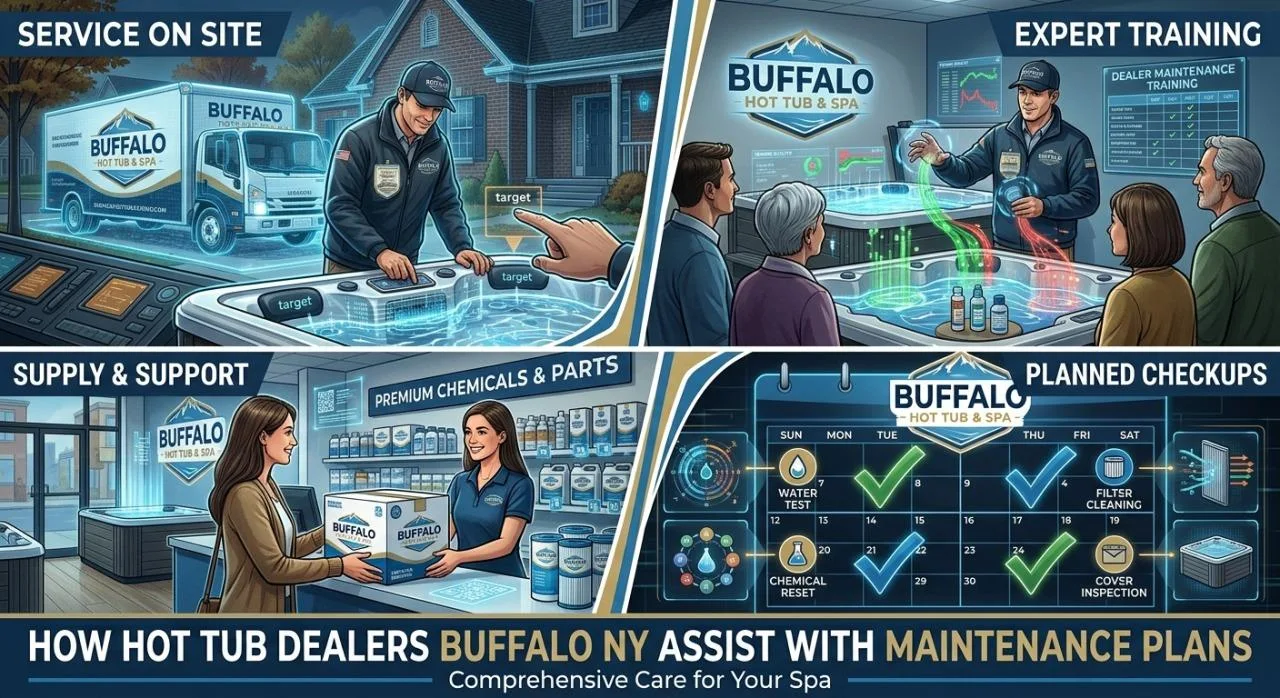
Investing in a home hot tub or spa provides a personal retreat for daily relaxation, hydrotherapy, and stress relief. However, long-term enjoyment of a spa requires consistent water balance, routine sanitation, and mechanical upkeep. In Western New York, where regional weather ranges from humid summer afternoons to sub-zero winter blizzards, managing spa chemistry and insulation systems can present unique seasonal challenges.
Partnering with a professional team or localized showroom simplifies these responsibilities. Rather than managing chemical ratios and mechanical checkups alone, local experts offer structured service programs, seasonal winterization, and water testing services that preserve water clarity and protect internal components year-round.
The Role of Structured Maintenance Plans
Maintaining a spa involves more than simply adding sanitizer or rinsing filters once a month. Water balance is affected by climate, frequency of bather use, local water hardness, and environmental debris. Without regular monitoring, unbalanced water can cause scaling on heating elements, skin irritation, or premature failure of internal plumbing seals.
A structured service plan takes the guesswork out of ownership. By setting up a recurring schedule for water balancing, mechanical checks, and system cleanings, owners preserve their equipment warranty, extend the operational lifespan of major components, and keep their water ready for immediate use.
Essential Services Offered in Regional Maintenance Programs
|
Service Component |
Operational Focus |
Primary Benefit to Owner |
Recommended Frequency |
|
Comprehensive Water Analysis |
Laboratory-grade testing for pH, alkalinity, hardness, and sanitizer levels |
Prevents scale buildup, corrosion, and skin or eye irritation |
Weekly to Bi-Weekly |
|
Filter Cleaning & Degreasing |
Deep soaking and high-pressure rinsing of cartridge filters |
Restores proper water flow and protects circulation pumps |
Monthly |
|
Full System Drain & Refill |
Draining existing water, purging lines, deep-cleaning the shell, and refilling |
Removes dissolved solids and chemical buildup for fresh water |
Every 3 to 4 Months |
|
Component Inspections |
Auditing heaters, jet pumps, ozone units, and pack plumbing |
Catches micro-leaks or electrical issues before major failures occur |
Quarterly |
|
Winterization & Freeze Protection |
Line blowing, anti-freeze flush, cabinet insulation audits, and thermal cover seals |
Protects plumbing and manifolds from freezing during severe weather |
Annually (Late Autumn) |
4 Strategic Ways Local Specialists Support Spa Owners
Managing a spa requires balancing technical equipment care with water chemistry. Working with an experienced local technician ensures your unit remains efficient, sanitary, and operational through every season.
1. Tailored Water Chemistry Solutions
Tap water characteristics vary significantly across different municipalities. Some areas feature high mineral content and hard water, while others present low alkalinity levels out of the tap. Working alongside a qualified hot tub dealer buffalo ny provides owners with custom chemical dosing schedules tailored directly to local water profiles, reducing chemical overuse and protecting internal heaters.
2. Specialized Seasonal Winterization and Freeze Protection
Western New York winters bring prolonged sub-freezing temperatures that pose a serious risk to filled or improperly shut-down hot tubs. Professional maintenance teams offer specialized winterization services, blowing out internal plumbing lines with high-volume air units and adding non-toxic marine-grade anti-freeze to prevent line expansion. For owners who use their spa year-round, technicians inspect thermal covers, cabinet insulation, and freeze-protection sensors to prevent unexpected freeze-ups during winter power outages.
3. Equipment Diagnostics and Preventative Repairs
Spas contain complex mechanical assemblies, including multi-speed pumps, titanium heaters, electronic control packs, and UV or ozone water purifiers. Scheduled service technicians perform diagnostic checks during routine visits, identifying worn gaskets, noisy bearings, or failing heating elements before they cause complete system shutdowns or water leaks.
4. Eco-Friendly and Automated Sanitation Upgrades
Modern spa care relies heavily on automated purification systems that reduce manual chemical dosing. Local technicians help owners retrofit older units or outfit new models with saltwater systems, ozone generators, or mineral-based cartridges. These upgrades streamline weekly upkeep, improve water clarity, and minimize harsh chemical odors.
Comparing Maintenance Approaches: DIY vs Service Contracts
Understanding the differences between managing your own spa care and enrolling in a professional service contract helps owners choose the best path for their lifestyle and budget.
|
Operational Feature |
Self-Managed Upkeep (DIY) |
Professional Service Plan |
|
Time Commitment |
1 to 3 hours per week for testing, scrubbing, and chemical additions |
Minimal; routine visits handled by trained technicians |
|
Chemical Knowledge Required |
High; requires understanding total alkalinity, pH balance, and sanitizers |
Low; experts handle chemical calculations and additions |
|
Equipment Monitoring |
Visual checks only; hard to spot early internal pump or heater failures |
Advanced diagnostics performed during scheduled maintenance visits |
|
Freeze Protection Security |
Owner must monitor power status and cover seals during severe freezes |
Certified line blowouts, thermal audits, and priority emergency response |
|
Long-Term System Lifespan |
Subject to owner consistency and chemical dosing accuracy |
Maximized through professional servicing and balanced water chemistry |
Preparing Your Spa for Changing Seasons
Western New York experiences four distinct seasons, each bringing specific care requirements to maintain optimal performance.
Spring and Summer Prep
- Biofilm Removal: Flushing internal plumbing with specialized line cleaners before draining removes bacteria and organic buildup accumulated over winter.
- UV and Sun Protection: Applying UV-protective conditioners to vinyl covers prevents cracking and fading caused by summer sun exposure.
- Filter Replacements: High summer bather loads require clean, unblocked filter media to maintain clear water and proper circulation rates.
Autumn and Winter Prep
- Thermal Cover Inspections: Inspecting cover foam cores for waterlogging guarantees heat retention when ambient temperatures drop below freezing.
- Cabinet and Insulation Audits: Sealing gaps in exterior cabinet paneling prevents cold air intrusion and deters small pests seeking shelter.
- Heater and Sensor Audits: Verifying that freeze-protection circuits and primary heating elements operate efficiently protects against frozen plumbing lines.
Detailed Water Chemistry Metrics for Regional Spa Care
Maintaining ideal water parameters prevents skin irritation, protects plumbing integrity, and prevents scaling across heating elements.
- pH Level Range: Keep pH strictly between 7.2 and 7.8. Below 7.2, water becomes acidic and corrodes metallic heater elements; above 7.8, sanitizer effectiveness drops drastically.
- Total Alkalinity: Maintain between 80 ppm and 120 ppm. Alkalinity acts as a buffer for pH, preventing sharp spikes or drops.
- Calcium Hardness: Target 150 ppm to 250 ppm. Low calcium leads to foaming and metal corrosion, while high calcium causes scaling along jet nozzles and shell walls.
- Free Sanitizer Levels: Maintain free chlorine between 3.0 ppm and 5.0 ppm, or bromine between 3.0 ppm and 6.0 ppm for continuous sanitation.
Pre-Season Maintenance Checklist
Use this operational checklist to evaluate your spa’s readiness for seasonal weather transitions.
Water Quality and Filtration
- [ ] Fresh Water Fill: Complete a full drain, pipe flush, and refill if water is older than 90 to 120 days.
- [ ] Filter Deep Clean: Soak cartridge filters in an enzymatic degreaser or replace filters older than 12 to 18 months.
- [ ] Water Balance Check: Verify that pH remains between 7.2 and 7.8 and total alkalinity sits between 80 and 120 ppm.
Hardware and Safety Systems
- [ ] GFCI Circuit Test: Trip and reset the main GFCI breaker to confirm electrical safety mechanisms function correctly.
- [ ] Cover Latch Check: Test cover tie-down straps and locks to secure the unit against high winds and heavy snow loads.
- [ ] Jet and O-Ring Inspections: Inspect jet nozzles for calcification and lubricate rubber O-rings with silicone sealant.
FAQs
How often should a home hot tub be completely drained and refilled?
Most manufacturers and service specialists recommend draining and refilling a spa every 3 to 4 months. Over time, dissolved solids, lotions, and chemical byproducts accumulate in the water, making chemical balancing difficult and reducing sanitizer efficiency.
Can a hot tub remain running outside during a Western New York winter?
Yes, modern spas are built with high-density foam insulation and automated freeze-protection systems designed for cold climates. Keeping the unit powered and setting water temperatures between 100°F and 104°F keeps the plumbing safe from freezing while offering a great winter hydrotherapy experience.
What happens if power goes out to my hot tub during a winter storm?
A well-insulated spa with a tight-fitting thermal cover can retain safe water temperatures for 24 to 48 hours during a power outage. Avoid opening the cover to trap internal heat. If an outage lasts longer, contact a local technician to safely drain the lines and prevent freezing.
Are saltwater sanitizing systems suitable for cold climate hot tubs?
Saltwater systems operate exceptionally well in cold climates. They continuously generate chlorine from natural salt, maintaining consistent sanitation without requiring frequent manual chemical additions during cold winter months.
Why is my spa water cloudy even though the sanitizer levels test fine?
Cloudy water despite correct sanitizer levels is usually caused by dirty or clogged filter cartridges, high total dissolved solids (TDS), or improper pH/alkalinity balance. Deep-cleaning the filter or completing a water change usually solves the issue.
What is the difference between a simple drain-and-refill service and a full system flush?
A basic drain-and-refill simply removes old water and replaces it with fresh water. A full system flush uses specialized plumbing cleaners prior to draining to scrub unseen biofilm, mold, and mineral scale from internal pipes and jets.
Conclusion
Proper spa maintenance requires balancing chemical testing, filter care, and equipment inspections. By establishing a service plan with local professionals, owners eliminate the stress of manual upkeep, protect their equipment against severe winter conditions, and ensure their spa provides clean, warm, therapeutic water all year long.