
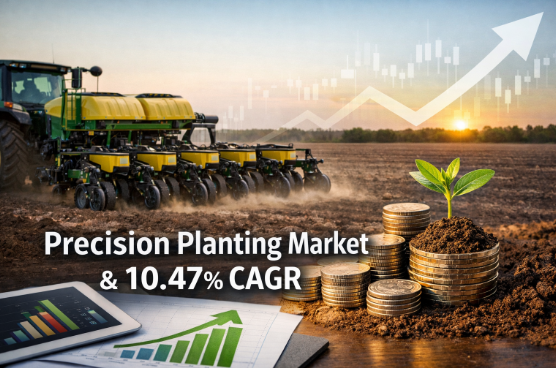
The Precision Planting Market has emerged as a critical component of modern agriculture, driven by the global need to improve crop productivity, optimize resource utilization, and reduce operational costs. Precision planting solutions enable farmers to place seeds at optimal depth, spacing, and timing, ensuring uniform crop emergence and higher yields. As agricultural practices increasingly adopt digital and automated technologies, precision planting has become a cornerstone of sustainable and data-driven farming systems. The growing emphasis on food security, coupled with the rapid integration of smart farming tools, continues to elevate the importance of the Precision Planting Market worldwide.
Precision Planting Market Size and Growth Outlook
According to the SNS Insider, The Precision Planting Market has demonstrated robust expansion over recent years, reflecting strong adoption across both developed and emerging agricultural economies. In 2023, the market generated revenue of approximately USD 5.00 billion and is projected to grow substantially over the next decade. By 2032, the Precision Planting Market is expected to reach USD 12.24 billion, advancing at a compound annual growth rate (CAGR) of 10.47% throughout the forecast period from 2024 to 2032. This consistent growth trajectory underscores the rising reliance on advanced planting technologies to enhance farm efficiency and crop performance.
Precision Planting Market Drivers Supporting Expansion
Several key factors are fueling the expansion of the Precision Planting Market. One of the primary drivers is the increasing global demand for higher agricultural output due to population growth and shrinking arable land. Precision planting systems allow farmers to maximize yield per hectare by ensuring accurate seed placement and minimizing wastage. Additionally, rising labor costs and workforce shortages in agriculture are encouraging the adoption of automated and technology-driven planting solutions. Government initiatives promoting smart agriculture and the growing availability of farm data analytics further strengthen the growth prospects of the Precision Planting Market.
Precision Planting Market Technology Advancements
Technological innovation plays a vital role in shaping the Precision Planting Market. Modern systems integrate GPS guidance, artificial intelligence, machine learning, and IoT-enabled sensors to deliver real-time insights and precise control during planting operations. Variable rate seeding, automated row shutoff, and advanced seed metering technologies are significantly improving planting accuracy and operational efficiency. These innovations not only reduce seed and input costs but also enhance crop uniformity, making technology upgrades a major contributor to the ongoing evolution of the Precision Planting Market.
Precision Planting Market Applications Across Crop Types
The Precision Planting Market serves a wide range of crop applications, including corn, soybeans, wheat, cotton, and other row crops. Large-scale commercial farms are among the primary adopters due to the high return on investment associated with precision planting equipment. However, small and medium-sized farms are increasingly embracing these solutions as technology becomes more accessible and affordable. The adaptability of precision planting systems across diverse soil conditions and crop types further broadens the scope and demand of the Precision Planting Market globally.
Precision Planting Market Regional Growth Trends
Regional dynamics significantly influence the Precision Planting Market landscape. North America holds a leading market share due to early technology adoption, strong mechanization levels, and the presence of major industry players. Europe follows closely, driven by sustainable farming policies and increased investment in precision agriculture technologies. Meanwhile, the Asia-Pacific region is anticipated to witness the fastest growth during the forecast period, supported by expanding agricultural activities, government support for smart farming, and rising awareness of yield optimization. These regional trends collectively contribute to the steady global expansion of the Precision Planting Market.
Precision Planting Market Competitive Landscape
The competitive environment of the Precision Planting Market is characterized by continuous product innovation, strategic partnerships, and mergers and acquisitions. Key market players focus on enhancing system accuracy, ease of integration, and compatibility with existing farm machinery. Investments in research and development remain high as companies aim to deliver advanced solutions that address evolving agricultural challenges. The presence of both established manufacturers and emerging technology providers ensures healthy competition, fostering innovation and sustained growth within the Precision Planting Market.
Precision Planting Market Challenges and Constraints
Despite its strong growth outlook, the Precision Planting Market faces certain challenges. High initial investment costs for advanced planting equipment can limit adoption, particularly among small-scale farmers. Additionally, technical complexity and the need for skilled operators may act as barriers in developing regions. Data integration and interoperability issues between different agricultural systems can also hinder seamless adoption. Addressing these challenges through training programs, financing options, and user-friendly technologies will be essential for unlocking the full potential of the Precision Planting Market.
Precision Planting Market Future Opportunities
The future of the Precision Planting Market appears promising, with significant opportunities emerging from digital agriculture and sustainable farming practices. The integration of cloud-based platforms, predictive analytics, and autonomous machinery is expected to redefine planting operations. Growing awareness of climate-smart agriculture and resource conservation will further accelerate demand for precision planting solutions. As innovation continues to lower costs and improve accessibility, the Precision Planting Market is well-positioned for long-term growth and technological advancement.
Precision Planting Market FAQs
Q1. What is the CAGR of the Precision Planting Market?
The Precision Planting Market is expected to grow at a compound annual growth rate (CAGR) of 10.47% during the forecast period from 2024 to 2032.
Q2. What is the forecast value of the Precision Planting Market by 2032?
By 2032, the Precision Planting Market is projected to reach a valuation of USD 12.24 billion, driven by technological advancements and increased adoption of precision agriculture practices.
Q3. Which region is expected to witness the fastest growth in the Precision Planting Market?
The Asia-Pacific region is anticipated to experience the fastest growth in the Precision Planting Market due to expanding agricultural activities, government initiatives, and rising demand for efficient farming technologies.