
Every family gathering produces it, and every child produces an answer. Astronaut, firefighter, vet. The answers are so consistent across decades and countries that they function less as ambition and more as a costume rack.
Elizabeth Tweedale, founder of the online coding school Coco Coders, remembers her daughter Ocean announcing at five, with the certainty available only at five, that she would be a veterinarian.
“She realized you actually have to deal with really sick pets,” Tweedale said. “The dream dissolved because the reality was sad, not just cuddly.”
Ocean got a correction. Most childhood career images never get one, and they harden into the outer edge of what a young person will consider.
Two studies mark out the problem. The OECD reported in 2020 that the career aspirations of seven-year-olds already reflect gender stereotypes and social background, and change very little by seventeen. Education and Employers surveyed more than 20,000 primary school children in 2018 and found that under one percent had learned about their chosen job from someone who visited their school. Television, social media and family occupation accounted for nearly all of it.
Put together, they describe a system in which a child assembles a shortlist from a narrow and non-random slice of the economy, and then chooses from that shortlist a decade later under exam pressure.
Tweedale founded Coco Coders in 2016 after a career spent patenting technical systems. Before designing the curriculum, her team interviewed US high school principals, who reported that students arrived with neither technical fluency nor a working map of the professional world.
The company’s answer is to teach the infrastructure behind familiar things. Children of primary and early secondary school age work through ten-week foundation blocks and four-week deep dives anchored on a real technology. In an ocean conservation module they study Mr. Trash Wheel, the solar-powered device pulling rubbish out of Baltimore’s Inner Harbor, then design their own response.
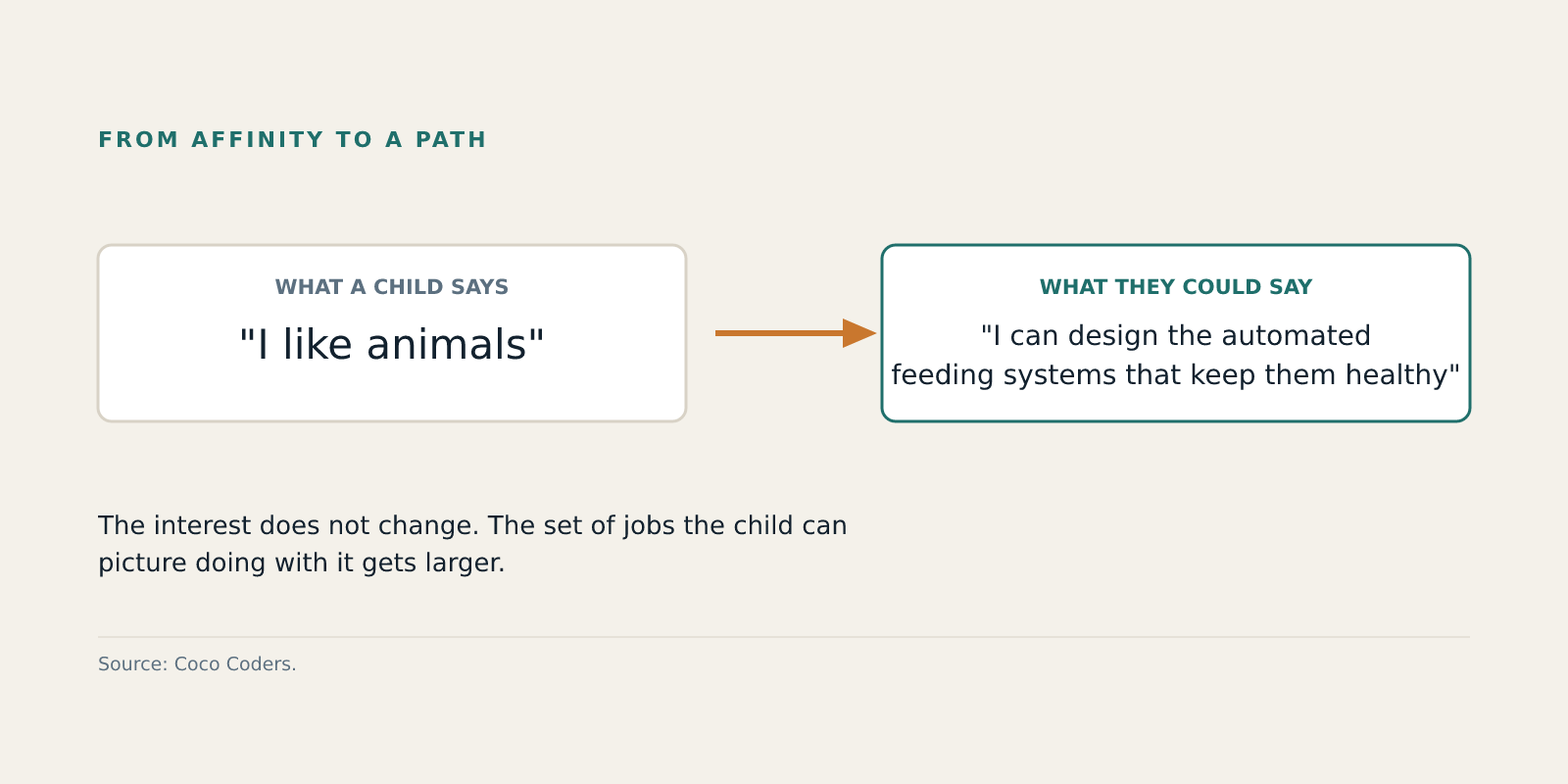
What that produces, when it works, is a small structural shift in how a child describes themselves. “I like animals” becomes “I could design the automated feeding systems that keep them healthy.” The interest is unchanged. The set of things the child can imagine doing with it is considerably larger.
A better version of the icebreaker exists, and it costs nothing. Ask a child what problem they would like to fix. The answers come out messier and they tell you more, because a problem is an interest and a job title is a costume.
“We’re solving longer-term problems,” she said. “The ones that don’t just exist for today, but for the world these kids are actually going to inherit.”
Coco Coders publishes its curriculum at cococoders.com.
About Coco Coders
Coco Coders is an online coding school founded in 2016 by Elizabeth Tweedale. It teaches Scratch, Python, HTML, CSS and JavaScript to school-age children through live interactive classes in group and private formats, and works with students in the United States, the United Kingdom and internationally. Course information is published at cococoders.com.
Leave a Reply
You must be logged in to post a comment.